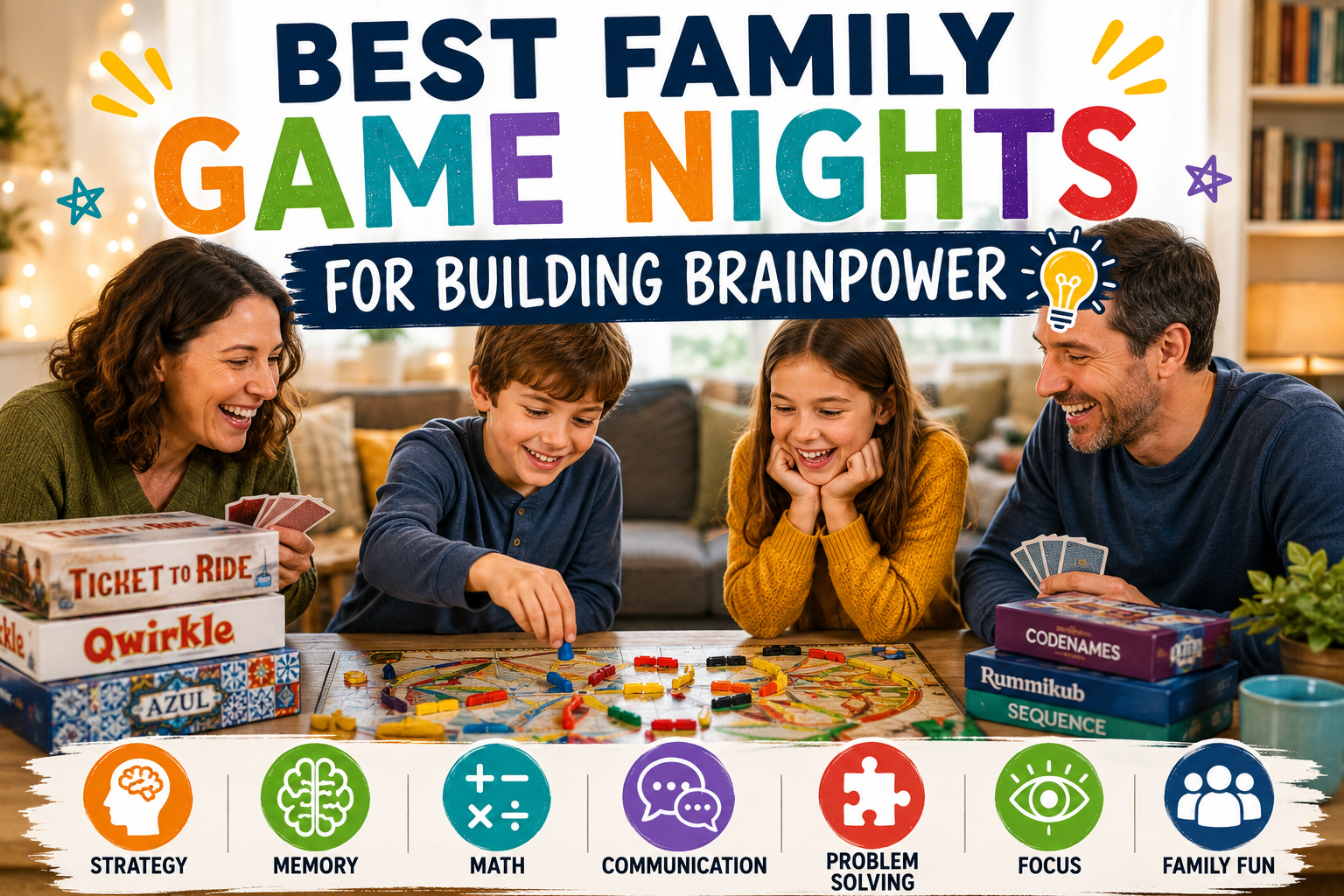
Best Family Game Nights for Building Brainpower
The Best Family Games for Building Brainpower
Family game night doesn’t have to mean another round of the same old board game.
The right games can quietly build memory, strategy, math skills, vocabulary, logic, communication, planning, and problem-solving while everybody is having fun.
That’s the sweet spot.
Kids don’t feel like they’re studying. Parents don’t have to create a lesson plan. Everyone gets to compete, laugh, make questionable decisions, and occasionally blame the rules.
Here’s my take on the best family games to put into regular rotation.
| Rank | Game | Brain Skills | Best For |
|---|---|---|---|
| 1 | Ticket to Ride | Strategy, planning, geography | Ages 8+ |
| 2 | Qwirkle | Pattern recognition, logic | Ages 6+ |
| 3 | Blokus | Spatial reasoning, strategy | Ages 7+ |
| 4 | Sequence | Strategy, probability, planning | Ages 7+ |
| 5 | Rummikub | Math, pattern recognition, strategy | Ages 8+ |
| 6 | Codenames | Vocabulary, communication, deduction | Ages 10+ |
| 7 | Rat-a-Tat Cat | Memory, math, probability | Ages 6+ |
| 8 | Sushi Go! | Strategy, probability, decision-making | Ages 8+ |
| 9 | Azul | Planning, visual pattern recognition | Ages 8+ |
| 10 | Spot It! | Observation, visual processing, speed | Ages 7+ |
Editor’s Pick
Ticket to Ride gets my vote for the best overall family brain game.
It’s easy enough to learn, but kids quickly discover that every decision matters. They have to plan routes, balance short-term and long-term goals, watch what other players are doing, and adapt when their plans get blocked.
That’s a lot of thinking disguised as colorful train cars.
1. Ticket to Ride
Best for: Strategy, planning, geography and decision-making
Recommended age: 8+
Ticket to Ride is one of the best games for teaching kids that decisions have consequences.
Players collect colored train cards and use them to claim railway routes between cities. Completing routes earns points, while unfinished destination tickets can cost points.
The clever part is that kids have to think ahead.
Do you grab the route you need now?
Do you collect cards for a longer route?
Do you block another player?
Should you chase a bigger scoring opportunity?
Those decisions build strategic thinking without making the game feel educational.
Brain skills it builds
Planning, probability, geography, risk assessment, flexible thinking and long-term strategy.
Family game night tip
Before starting, let younger kids look at the map and identify a few cities. You’re sneaking geography into game night without turning it into a worksheet.
2. Qwirkle
Best for: Pattern recognition and logic
Recommended age: 6+
Qwirkle looks simple.
That’s part of why it’s so good.
Players build rows and columns by matching colors or shapes without repeating the same combination. Each turn forces players to look at the board, identify possible patterns, and decide where their pieces create the most value.
Kids are practicing visual discrimination and logical thinking almost every turn.
The hidden lesson
The game teaches kids to ask:
“What pattern do I see?”
Then:
“Where can I use it?”
That’s a foundational reasoning skill.
3. Blokus
Best for: Spatial reasoning and strategy
Recommended age: 7+
Blokus is fantastic for kids who enjoy puzzles and building.
Players place geometric pieces on the board, but each new piece must connect to their own pieces by corners while avoiding edge-to-edge contact with their existing pieces.
Sounds easy?
Try it.
The board gets crowded fast.
Kids have to visualize where pieces will fit several turns ahead. They learn to think spatially, recognize shapes, and adapt when another player takes the space they wanted.
Why I like it
Blokus doesn’t depend heavily on reading.
That makes it a great choice for mixed-age families.
4. Sequence
Best for: Strategy, planning and probability
Recommended age: 7+
Sequence blends cards and board-game strategy.
Players use cards to place chips on matching spaces and try to create rows of five. Special cards can change the board, making the game more unpredictable.
Kids quickly learn that placing a piece isn’t just about the move in front of them.
They need to think:
“What will this move allow me to do next?”
That’s the beginning of strategic planning.
It also gives children practice recognizing threats and opportunities on the board.
5. Rummikub
Best for: Math, patterns and logical thinking
Recommended age: 8+
Rummikub quietly turns numbers into a puzzle.
Players arrange numbered tiles into runs and groups, constantly reorganizing their tiles to create new combinations.
That means kids are practicing number relationships without doing traditional math problems.
They’re looking at sequences, comparing values, sorting information and calculating what combinations are possible.
Why it works
Kids don’t think:
“I’m practicing number sequencing.”
They think:
“How can I get rid of these tiles?”
Exactly.
6. Codenames
Best for: Vocabulary, communication and deduction
Recommended age: 10+
Codenames works a different part of the brain.
Players try to connect words using a single-word clue while avoiding words that could point teammates in the wrong direction.
That requires players to consider multiple meanings and connections.
A good clue needs to be specific enough to guide your team but broad enough to connect multiple words.
That’s harder than it sounds.
Brain skills it builds
Vocabulary, association, communication, deductive reasoning, perspective-taking and flexible thinking.
It’s also one of the better games for older kids, teens and adults who usually claim board games are “for little kids.”
7. Rat-a-Tat Cat
Best for: Memory and basic math
Recommended age: 6+
Rat-a-Tat Cat is especially good for younger children.
Players have cards with hidden values and try to finish with the lowest score while remembering where their cards are located.
The game rewards attention and memory.
Kids also start working with relative values and basic mathematical comparison.
Make it more challenging
After your child becomes comfortable with the game, ask them to explain why they think a particular move is better.
You’re adding reasoning to the gameplay without changing the rules.
8. Sushi Go!
Best for: Strategy, probability and decision-making
Recommended age: 8+
Sushi Go! proves that a fast game can still make kids think.
Players draft cards and build combinations that score points. The trick is that players must decide which card to keep while passing the rest to another player.
Every round creates a new decision.
Do you take the card you need now?
Do you deny another player a valuable card?
Do you chase a set?
Do you play it safe?
This gives kids a simple introduction to probability, opportunity cost and strategic decision-making.
And the game moves quickly.
That’s a win for families with limited attention spans.
9. Azul
Best for: Visual planning and pattern recognition
Recommended age: 8+
Azul is gorgeous, but don’t let the pretty tiles fool you.
There’s plenty of strategy hiding underneath.
Players collect colored tiles and place them into patterns while trying to maximize points and avoid penalties.
The game encourages children to think several steps ahead and recognize how one decision affects future options.
The hidden brain workout
Azul helps develop:
Pattern recognition
Spatial planning
Decision-making
Attention to detail
Strategic thinking
It’s also quiet enough that parents can actually have a conversation while playing.
Huge bonus.
10. Spot It!
Best for: Observation and visual processing
Recommended age: 7+
Spot It! is one of the easiest games to pull out when you only have a few minutes.
Players race to identify the matching symbol between cards.
It sounds incredibly simple.
Then everyone starts yelling.
The game rewards rapid visual scanning, concentration and quick decision-making.
For younger kids, it’s a great way to practice identifying similarities and differences.
Why short games matter
You don’t always need a two-hour strategy marathon.
A 10-minute game can still create a useful mental workout, especially when families play regularly.
What Makes a Family Game Good for Brain Development?
A game doesn’t need an educational label to be useful.
In fact, some of the best brain-building games simply create situations where kids need to make decisions.
Look for games that require children to:
Remember information
Memory games and games with hidden information make kids pay attention and hold information in their minds.
Plan ahead
Strategy games encourage children to think beyond the immediate move.
Recognize patterns
Pattern-based games build visual and logical reasoning.
Solve problems
The best games create obstacles that require players to find solutions.
Communicate
Word and team games help kids explain ideas and understand how other people think.
Adapt
A strong game doesn’t let you follow the same plan every time. Players need to react when the board changes.
That’s a real-world skill too.
The Best Family Game by Brain Skill
Best for strategy: Ticket to Ride
Kids have to plan, prioritize and adapt.
Best for math: Rummikub
Numbers become something to manipulate instead of memorize.
Best for vocabulary: Codenames
Children have to think about word relationships and meaning.
Best for spatial reasoning: Blokus
The entire game revolves around visualizing space.
Best for pattern recognition: Qwirkle
The rules force players to identify and extend patterns.
Best for memory: Rat-a-Tat Cat
Players have to remember hidden information while making decisions.
Best for quick thinking: Spot It!
It’s fast, simple and surprisingly challenging.
Best for mixed ages: Sequence
The rules are easy to understand while the strategy can grow with the players.
How to Make Family Game Night More Educational Without Making It Boring
Here’s the trick.
Don’t turn game night into school.
You don’t need to stop after every turn and explain the cognitive skill your child just practiced.
That’ll kill the fun pretty quick.
Instead, occasionally ask a question.
“Why did you choose that move?”
“What do you think I’m going to do?”
“Would you make the same move again?”
“What would happen if you tried something different?”
These questions encourage kids to explain their thinking.
That’s where a lot of the learning happens.
Let Kids Teach the Rules
This is one of my favorite family game-night tricks.
After your child learns a game, have them teach it to someone else.
Teaching requires them to organize information, remember rules, explain concepts clearly and answer questions.
That’s a serious mental workout hiding inside five minutes of explanation.
And kids usually love being the expert.
Keep a Family Game Rotation
Don’t buy 20 games and expect everybody to play them.
Create a small rotation.
For example:
Monday: Quick strategy game
Wednesday: Word or memory game
Friday: Longer family strategy game
Weekend: Let the kids choose
This keeps game night fresh without turning your house into a board-game warehouse.
One other thing: let kids lose.
Seriously.
Winning feels great, but losing teaches patience, emotional control, adaptation and resilience.
You don’t need to let your child win every time.
They need to learn how to handle a bad hand too.
How Long Should Family Game Night Last?
There isn’t a magic number.
For younger kids, 20 to 30 minutes may be perfect.
Older children and teens may enjoy 45 to 90 minutes.
The goal isn’t to maximize playing time.
The goal is to make family game night something everyone looks forward to.
When the kids start asking, “Can we play another one?” you’ve got it right.
Family Game Night Doesn’t Need to Be Complicated
You don’t need elaborate crafts, educational worksheets or a special setup.
Grab a game.
Put away the phones.
Make some popcorn.
Play.
Talk.
Laugh.
Argue about whether that move was legal.
Then play again.
The best family game nights build something bigger than academic skills. They give kids repeated practice with thinking, communication, patience and decision-making while giving families actual time together.
That’s a pretty good trade.
What’s the best overall family game for building brainpower?
My overall pick is Ticket to Ride because it combines strategy, planning, geography, decision-making and adaptability without becoming so complicated that younger players feel lost.
But the best game is ultimately the one your family will actually play.
A simple game played every Friday beats an expensive strategy game that stays in the closet.
Frequently Asked Questions
Do board games actually improve kids’ brain skills?
Many board games give children practice with skills such as memory, strategic planning, pattern recognition, communication, mathematical reasoning and problem-solving. The biggest benefit comes from regularly engaging with games that require children to actively think and make decisions.
What is the best family game for kids and adults to play together?
Ticket to Ride is my top choice for a broad age range. The rules are approachable, but adults and older kids can develop more advanced strategies over time.
Sequence is another strong choice for families who want something easier to learn.
What family game is best for math skills?
Rummikub is one of the strongest choices because players constantly work with numbers, sequences and combinations.
Games involving money, counting, probability or resource management can also give kids useful math practice.
What family games help with reading and vocabulary?
Codenames is the obvious pick for older children and teens. It requires players to understand word meanings, relationships and associations.
For younger children, matching and word-building games can provide similar benefits at a simpler level.
What is the best game for younger children?
For children around 5 to 7, look for games with simple rules and short playing times.
Games such as Rat-a-Tat Cat, Spot It! and age-appropriate matching or pattern games work well because children can understand the objective without spending 20 minutes learning complicated rules.
Should I let my child win family games?
You don’t need to.
Letting kids occasionally win feels great, but always giving them the victory removes some of the value of competition.
Losing can teach kids how to handle disappointment, change strategies and try again.
Be a good sport yourself, too.
Kids copy what they see.
How often should families have game night?
Once a week is a great starting point.
You don’t need a formal weekly event, though. Even 20 minutes of regular game play can create valuable family time.
Consistency matters more than duration.
Are educational board games better than regular board games?
Not necessarily.
A game doesn’t need to advertise itself as educational to build useful skills.
Some traditional strategy, card and word games require more planning and reasoning than games specifically marketed as “educational.”
Focus on the type of thinking the game requires.
What if my child gets frustrated when they lose?
Start with shorter games and choose games where the outcome can change quickly.
You can also model healthy reactions when you lose.
Say something like, “That didn’t work. Next round I’m trying a different strategy.”
You’re showing your child that losing provides information.
That’s a useful mindset far beyond game night.
Can teenagers still benefit from family game night?
Absolutely.
Older kids can handle games involving probability, strategy, negotiation, deduction and complex decision-making.
Games such as Codenames, Ticket to Ride and Azul can work especially well for teens because they offer enough strategic depth to keep adults interested too.
Amazon Affiliate Disclosure: This article may contain affiliate links. If you purchase a product through one of these links, we may earn a commission at no additional cost to you. We only recommend products we believe offer useful value for families.