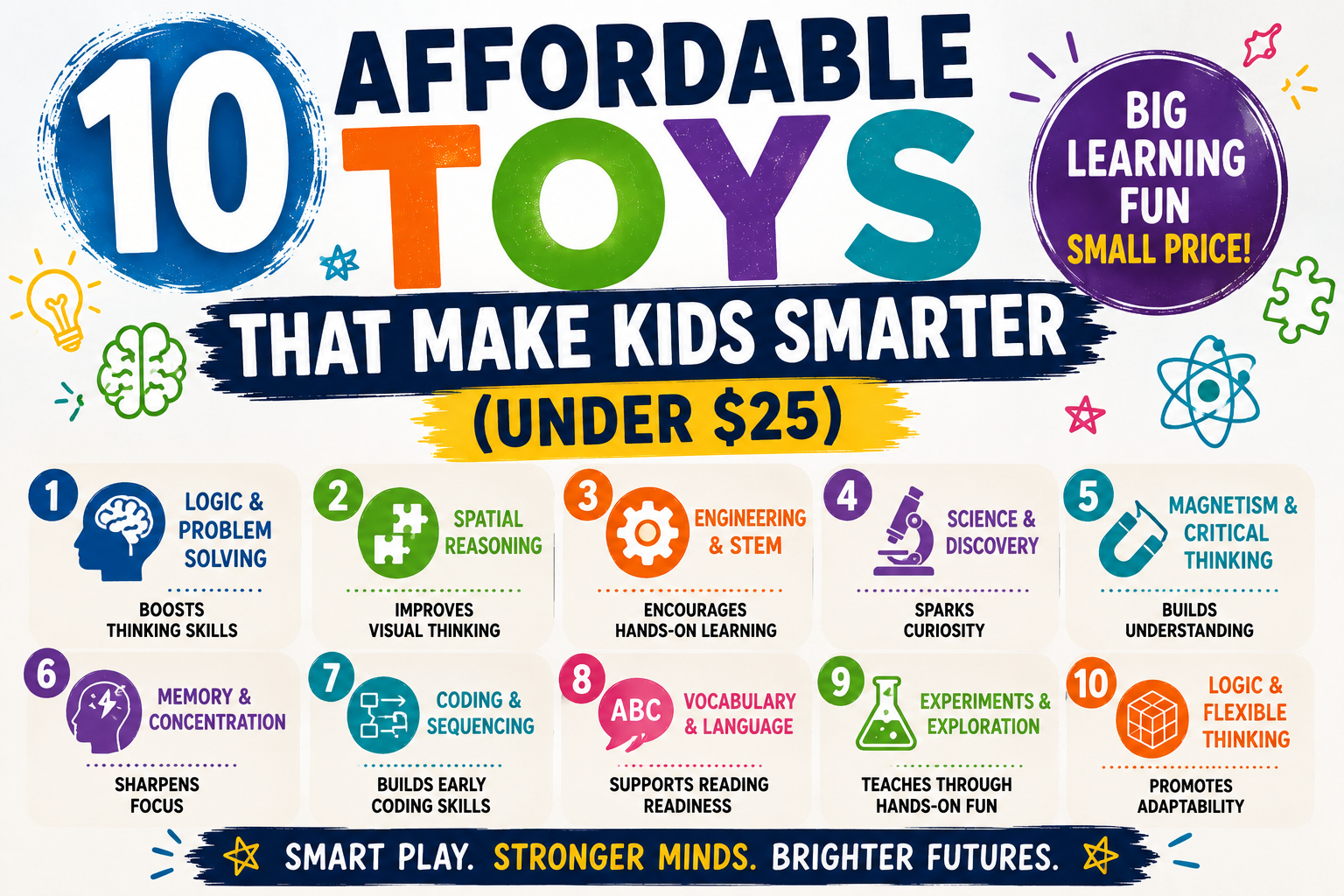
10 Affordable Toys That Make Kids Smarter (Under $25)
10 Affordable Toys That Make Kids Smarter
You don’t need to spend $50, $75, or $100 on a toy to give your child a meaningful brain workout.
Some of the best learning toys are inexpensive, simple, and easy to pull out whenever your child has a few minutes to play. The trick is choosing toys that make kids think, build, remember, compare, solve, and experiment instead of simply pushing a button and watching something happen.
One quick clarification: no toy magically makes a child “smarter.” What good toys can do is give kids repeated practice with skills that support learning, such as memory, spatial reasoning, math, pattern recognition, problem-solving, and attention.
And that’s exactly what this list is about.
Best Brain-Building Toys Under $25
| Rank | Toy | Skill Focus | Approx. Price |
|---|---|---|---|
| 1 | ThinkFun Gravity Maze | Logic & spatial reasoning | $22.79 |
| 2 | Educational Insights Kanoodle Genius | Problem-solving & spatial reasoning | $15.65 |
| 3 | Learning Resources STEM Explorers Machine Makers | Engineering & physics | $16.99 |
| 4 | Educational Insights GeoSafari Kidscope | Science & observation | $18.83 |
| 5 | Learning Resources Magnet Movers | Magnetism & critical thinking | $20.49 |
| 6 | Educational Insights BrainBolt | Memory & concentration | $23.99 |
| 7 | Learning Resources STEM Explorers Suncatchers | Coding & sequencing | $19.99 |
| 8 | ThinkFun Zingo! | Vocabulary & matching | $19.99 |
| 9 | Learning Resources Super Hero Science Set | Science & experimentation | $17.49 |
| 10 | Learning Resources Brainometry Cubed | Logic & flexible thinking | $11.99 |
Prices shown are current examples from online retailers and can change. Several of these products are currently listed under $25 at Walmart or Target.
Editor’s Pick
ThinkFun Gravity Maze is my favorite overall pick because it combines hands-on building with genuine logic and spatial reasoning challenges. Good Housekeeping currently lists it at about $23, with 60 engineering challenges that ask kids to build marble paths and solve increasingly difficult problems.
The best part?
Kids usually think they’re playing with a marble maze.
They’re actually planning several moves ahead.
1. ThinkFun Gravity Maze
Best for: Logic, spatial reasoning and problem-solving
Recommended age: 8+
Think of Gravity Maze as a puzzle and engineering challenge rolled into one.
Kids use towers, tracks and marbles to create paths that solve specific challenges. They have to visualize how the pieces interact before they make a move.
What kids are practicing
Spatial reasoning is the big one.
They’re also learning:
Problem-solving
Planning
Cause and effect
Logical sequencing
Trial and error
The current version includes 60 challenges and three marbles, making it useful for repeated play rather than a toy that gets solved once and forgotten.
Why it’s worth the money
At roughly $23, it’s a relatively inexpensive way to give an older child a legitimate logic workout.
2. Educational Insights Kanoodle Genius
Best for: Spatial reasoning and critical thinking
Recommended age: 8+
Kanoodle Genius is tiny.
The amount of brainpower packed into it isn’t.
Kids use puzzle pieces to complete different 2D and 3D challenges. The compact case also doubles as the playing surface, so it’s easy to throw into a backpack for road trips, restaurants or waiting rooms.
The current Walmart listing is around $15.65 and includes seven puzzle pieces and a challenge guide.
The hidden lesson
Kids have to figure out:
Which piece fits?
Which way should it turn?
What space needs to stay open?
That’s spatial reasoning in action.
And because the puzzle only has one solution for many challenges, kids can’t simply guess their way through it.
3. Learning Resources STEM Explorers Machine Makers
Best for: Engineering, physics and construction
Recommended age: 5+
This is one of my favorite budget STEM toys for younger kids.
Machine Makers lets children build twisting, moving machines inspired by real-world engineering. The current set includes 60 pieces and nine STEM challenges, with projects based on things such as cranes, satellite dishes and space rovers.
The current Walmart price is about $16.99.
That’s a lot of hands-on engineering for the price.
What kids learn
Force
Movement
Structure
Mechanical systems
Planning
Fine motor skills
And perhaps most importantly, they learn that their first design doesn’t have to work perfectly.
Build.
Test.
Change it.
Try again.
That’s engineering.
4. Educational Insights GeoSafari Kidscope Microscope
Best for: Observation and early science
Recommended age: 5+
A microscope gives kids a completely different way to look at ordinary things.
The GeoSafari Kidscope currently sells for under $20 and includes a kid-friendly microscope, LED light, 15 prepared slides, 60 images and a science guide containing more than 200 facts.
Why I like it
Kids naturally ask questions when they can see something they couldn’t see before.
“What is that?”
“Why does it look like that?”
“Is this different?”
That’s where curiosity takes over.
Give your child a leaf, piece of fabric, flower petal or another safe object and suddenly you have a science activity that costs almost nothing.
5. Learning Resources STEM Explorers Magnet Movers
Best for: Magnetism and critical thinking
Recommended age: 5+
Magnets are fantastic for young scientists because the effect is immediate.
Kids can push, pull, attract and repel objects and start forming ideas about invisible forces without needing a complicated explanation.
The STEM Explorers Magnet Movers set currently sells for about $20.49 and is designed around hands-on exploration of magnetic forces.
Turn it into a mini experiment
Ask your child to predict whether an object will move before testing it.
Then ask why.
That’s it.
You’ve turned simple play into a prediction-and-observation exercise.
6. Educational Insights BrainBolt
Best for: Memory, focus and concentration
Recommended age: 7+
BrainBolt is a handheld electronic memory game that challenges kids to remember patterns and repeat them correctly.
The current listing is around $23.99 and describes the game as a screen-free activity focused on concentration, reaction time and memory.
Why it works for short attention spans
You don’t need 45 minutes.
Kids can play for five or ten minutes and then put it away.
That’s useful for families looking for quick activities during:
Car rides
Restaurant waits
Quiet time
After-school breaks
It’s also much easier to convince a child to play a quick brain challenge than sit down for another worksheet.
7. Learning Resources STEM Explorers Suncatchers
Best for: Coding concepts, sequencing and creativity
Recommended age: 5+
Here’s a clever crossover.
Suncatchers looks like an arts-and-crafts activity, but the STEM components add logic and sequencing to the experience.
The current Target listing is $19.99 and describes the set as a 433-piece, screen-free STEM activity that has children build and rebuild window-ready designs while solving projects.
That’s the beauty of STEAM
Kids don’t always need to know they’re learning a STEM skill.
They’re creating something pretty.
At the same time, they’re following sequences, making decisions, recognizing patterns and solving design problems.
That’s a win.
8. ThinkFun Zingo!
Best for: Vocabulary, language and matching
Recommended age: 4+
Not every brain-building toy needs to involve robots or science.
Zingo! uses a bingo-style format to help younger children practice matching and language skills.
The current Walmart listing is about $19.99 and specifically positions the game for pre-readers and early readers.
Why it’s useful
Young children are working on:
Word recognition
Matching
Visual scanning
Attention
Vocabulary
Following rules
The game also works well as a family activity, which makes it easier to get repeated use from it.
9. Learning Resources STEM Explorers Super Hero Science Set
Best for: Experiments and scientific thinking
Recommended age: 6+
This is a smart way to introduce kids to science without making science feel like school.
The Super Hero Science Set currently sells for about $17.49 and uses superhero-themed experiments to explore ideas such as magnetism, levitation and color mixing.
The theme does half the marketing for you.
Tell a child they’re learning about magnetic forces?
Maybe they’ll be interested.
Tell them they’re going to perform a superhero experiment?
Now we’re talking.
The real value
The experiments encourage kids to make predictions and observe results.
That’s one of the core habits of scientific thinking.
10. Learning Resources Brainometry Cubed
Best for: Logic, memory and flexible thinking
Recommended age: 7+
Want a brain toy that doesn’t take up half the playroom?
Brainometry Cubed is a compact set of handheld brain teasers.
The current Walmart price is around $11.99.
Why inexpensive puzzles can be great
There’s no setup.
No batteries.
No large box.
No complicated instructions.
Just a small puzzle that gives kids something to figure out.
That makes these types of toys especially useful for quick mental workouts.
What Makes a Toy Actually Good for Brain Development?
Here’s where parents can get fooled.
A toy can have “educational” printed across the box and still provide very little meaningful thinking.
Look for toys that make kids do something.
The strongest budget toys tend to ask children to:
Solve a problem
Remember information
Build something
Recognize patterns
Predict an outcome
Make a choice
Explain their thinking
Change their strategy
Try again
That’s the stuff you want.
The Best Toy Under $25 for Each Skill
Best for problem-solving
Gravity Maze
Kids have to solve increasingly difficult physical challenges.
Best for spatial reasoning
Kanoodle Genius
The puzzle requires kids to visualize how pieces fit together.
Best for STEM
Machine Makers
It combines construction, physics and engineering.
Best for science
GeoSafari Kidscope
It turns ordinary objects into things worth investigating.
Best for memory
BrainBolt
Short rounds make it easy to practice repeatedly.
Best for language
Zingo!
It’s simple enough for younger children while still providing useful vocabulary practice.
Best for experiments
Super Hero Science Set
Hands-on activities make science feel like play.
Best budget pick
Brainometry Cubed
At around $12, it’s one of the cheapest ways to add a logic challenge to a child’s toy collection.
You Don’t Need a Huge Toy Budget
This is the part I think parents sometimes overlook.
You don’t need a playroom full of expensive educational gadgets.
I’d rather own three $20 toys that get played with every week than one $100 toy that gets opened once.
A good toy should have repeat value.
Can your child solve another challenge?
Can they build something different?
Can they change the rules?
Can they test another idea?
Can they come back to it six months from now and still discover something new?
That’s what makes a toy worth buying.
How to Make an Affordable Toy Even More Educational
The easiest trick doesn’t cost anything.
Ask questions.
“What do you think is going to happen?”
“Why did that happen?”
“What could you change?”
“Can you make it harder?”
“Can you find another way?”
“Can you explain your solution to me?”
Don’t give the answer too quickly.
A few seconds of frustration can be useful.
Kids need room to struggle with a problem before someone swoops in and fixes it.
Create a $50 Brain-Building Toy Box
You don’t even have to spend $25 on every item.
You could create a surprisingly strong learning collection with a few inexpensive purchases.
For example, combine a small logic puzzle, a magnetic STEM toy and a science experiment kit.
That gives you three very different types of play:
Think
Build
Experiment
And you can swap them based on your child’s mood.
The Best Toys Grow With the Child
A great educational toy can become more interesting as a child gets better at using it.
That’s what you want.
At first, they may simply follow directions.
Later, they start modifying the design.
Eventually, they start inventing their own challenges.
That’s when the toy gets really interesting.
The product hasn’t changed.
The child has.
Don’t Need To Spend A Fortune
You don’t need to spend a fortune to give kids toys that encourage real learning.
Some of the best options under $25 are small, simple and surprisingly challenging.
My top three are Gravity Maze for logic, Machine Makers for STEM and GeoSafari Kidscope for science.
But don’t overthink it.
Pick something that matches your child’s interests.
A toy that gets used 50 times is far more valuable than an expensive “educational” toy that sits untouched in a closet.
And that’s really the secret.
The best brain-building toy is the one your child actually wants to play with.
Frequently Asked Questions
Can affordable toys really help kids learn?
Yes. The price of a toy doesn’t determine how much thinking it encourages.
An inexpensive puzzle can require more reasoning than a much more expensive electronic toy. The key is whether the toy gives children opportunities to solve problems, remember information, recognize patterns, build, experiment and make decisions.
What is the best educational toy under $25?
My overall pick is ThinkFun Gravity Maze because it combines physical play with logic, spatial reasoning and problem-solving.
For younger children, Machine Makers is a strong alternative.
What is the best STEM toy under $25?
Learning Resources STEM Explorers Machine Makers is one of the strongest budget options because kids build moving machines and solve multiple engineering challenges.
Current retailer listings show it below $20.
What is the best toy for memory?
BrainBolt is a good choice for children who enjoy quick challenges.
It uses patterns and repeated recall, giving kids a simple way to practice concentration and memory.
What toy helps with math skills?
Look for toys involving counting, sequencing, patterns, measurement and spatial reasoning.
For younger children, construction toys and math manipulatives work well. For older children, logic puzzles and strategy games can make math concepts feel more natural.
Are STEM toys only for older kids?
No.
Young children can explore STEM through building, sorting, magnets, simple machines, patterns and cause-and-effect play.
Younger children don’t need complicated robotics kits.
A simple construction toy can be enough to get them thinking.
What should I look for when buying an educational toy?
Look for repeat play, open-ended possibilities and active thinking.
A toy becomes more valuable when kids can change the design, attempt multiple challenges, make predictions or discover different solutions.
Should educational toys replace screen time?
They don’t need to replace every minute of screen time.
The goal should be balance.
Hands-on toys give kids opportunities to build, manipulate objects, experiment and solve physical problems in ways that a screen-based activity may not.
How many educational toys does a child need?
Not many.
I’d rather have a small collection of toys that serve different purposes than dozens of toys that do roughly the same thing.
A logic toy, building toy, science kit and creative activity can cover a lot of ground.
What’s the cheapest brain-building toy on this list?
Learning Resources Brainometry Cubed is currently around $11.99, making it one of the most affordable options here.
Do kids need expensive toys to become good at STEM?
No.
STEM skills develop through activities that encourage children to ask questions, test ideas, build things, solve problems and learn from mistakes.
A $20 kit that gets used repeatedly can be more valuable than a $100 gadget that stays in the box.
How can parents make educational toys more effective?
Play with your child occasionally, but don’t take over.
Ask questions.
Encourage them to explain their thinking.
Let them make mistakes.
Most importantly, give them time to figure things out themselves.
That’s where a lot of the real learning happens.
Amazon Affiliate Disclosure: This article may contain affiliate links. If you purchase a product through one of these links, we may earn a commission at no additional cost to you. We only recommend products we believe offer useful value for families.
Prices and availability can change. Check the retailer listing before purchasing.