Are Squishy and Fidget Toys Good for Kids? What Parents Should Know
This post contains affiliate links. As an Amazon Associate, Let’s Think Toys earns from qualifying purchases. If you buy through one of our links we may earn a small commission at no extra cost to you. Read our full disclosure.
Squishies are everywhere this year. Retailers can’t keep some of them in stock, and if you have a kid between 5 and 12, there’s a decent chance one is on their wish list right now.
So are they actually good for kids? Or just the new slime?
Short answer: it depends on the kid, the toy and where they’re using it. A quiet squishy can help some kids calm down. A flashy fidget at a desk mostly just distracts. Here’s what the research says, what to buy if you’re going to, and the one “sensory toy” you should keep out of the house entirely.
What the Research Actually Says
Less than the marketing does. A 2023 review of fidget toy studies (Kriescher and colleagues) found limited research overall and no solid evidence that fidget toys improve attention or behavior across the board. Some studies found the opposite. In one classroom study of young kids with ADHD, fidget spinners led to more distraction, not less.
But there’s another side. Research on movement suggests some kids with ADHD do better on attention tasks when they’re allowed to move a little, and a small study of sixth graders who used stress balls in class found they reported better attention. A single study of three second graders with ADHD saw more on-task behavior when fidget use came with clear rules.
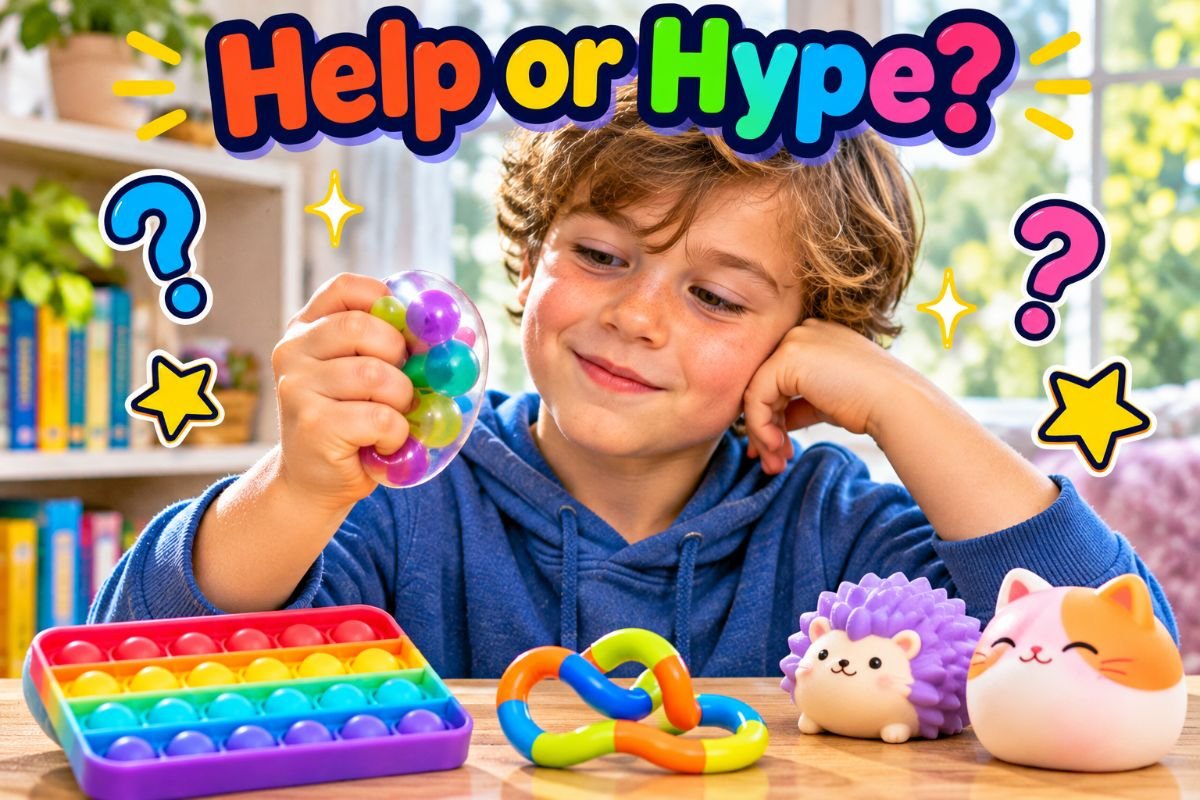
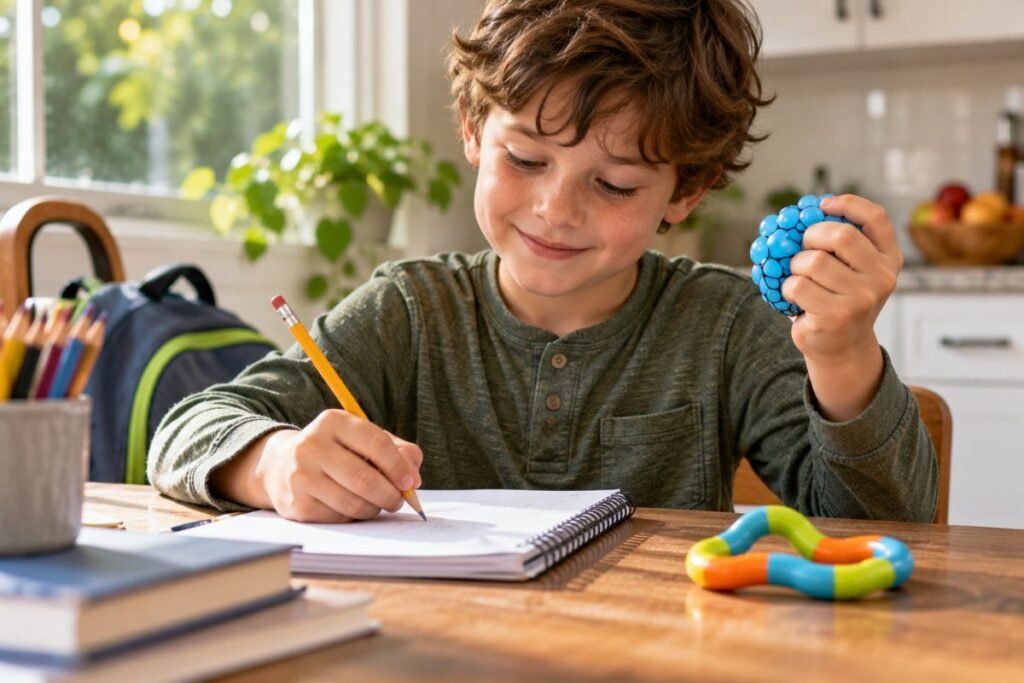
Our take? The type of fidget matters a lot. Things you have to look at (spinners, light-up toys, pop-its) pull attention away. Things you can squeeze without looking (stress balls, quiet squishies, a Tangle) are more likely to help a restless kid stay put.
When Fidget Toys Help
They tend to help kids who are restless, anxious or need something to do with their hands while they listen, like during a read-aloud, a long car ride or a stressful appointment. Some kids just think better when their hands are busy.
They’re also great as a calm-down tool. Squeezing something slow and squishy gives a wound-up kid a physical way to settle.
When They Get in the Way
When the fidget becomes the activity. If your kid is watching the toy instead of the teacher, it’s a toy, not a tool. Some teachers use a simple rule: a tool stays in your hand and out of your eyes. Break the rule, lose the tool for the day.
Also worth saying: if you’re seeing real trouble with focus or anxiety, a fidget isn’t a fix. Talk to your pediatrician or your child’s teacher.
The One Sensory Toy to Skip: Water Beads
Water beads look like candy and expand when they get wet. If a child swallows one, it can keep growing inside their body and cause a blockage that needs surgery. At least one baby has died after swallowing them. Thousands of kids have been treated in emergency rooms for water bead incidents, according to the U.S. Consumer Product Safety Commission.
New federal rules took effect in March 2026 that ban the most dangerous types from being sold as toys, and major retailers stopped selling them as toys back in 2023. But older ones are still in homes, and decorative beads are still sold. Our advice matches safety advocates: keep them out of any house with kids or pets. See our Toy Safety 101 guide for other hazards worth knowing.
Fidget Toys Worth Buying
1. Schylling NeeDoh Nice Cube
Best for: Quiet squeezing
A squishy cube that’s silent, slow and doesn’t roll off the desk. If your kid wants a squishy, this is the kind least likely to drive a teacher up the wall.
Check the price of Schylling NeeDoh Nice Cube on Amazon →
2. Tangle Jr. Fidget
Best for: Busy hands, no noise
Twistable linked segments that click quietly into new shapes. It’s small, it stays in one hand, and there’s nothing to look at, which matters (see below).
Check the price of Tangle Jr. Fidget on Amazon →
3. Kinetic Sand
Best for: Sensory play at home
Sand that sticks to itself and doesn’t make a huge mess. Better as a calm-down activity at the table than a classroom fidget.
Check the price of Kinetic Sand on Amazon →
4. Stress Balls for Kids
Best for: The classic
Plain foam or gel stress balls are cheap, quiet and the type with the most (small) research behind them. Boring can be good.
Check the price of Stress Balls for Kids on Amazon →
5. Pop It Fidget Toy
Best for: Fun, not focus
Kids love these. They’re also loud-ish and very look-at-me. Fine for the car or a waiting room. We wouldn’t send one to school.
Check the price of Pop It Fidget Toy on Amazon →
How to Make Fidgets Work at Home
Pick one quiet fidget and give it a job: homework time, reading time, the car. Set the rule up front (hands, not eyes). And check in after a week. If homework got easier, great. If it turned into a squish-fest, put it away and try something else.
Small kids are a different story. Many squishies and fidgets have small parts or can be bitten into pieces, so check the age label. Most are made for kids 3 and up, and some for older.
FAQ
Are fidget toys good for kids with ADHD?
The evidence is mixed. Some research suggests movement helps some kids with ADHD focus, but studies on fidget toys themselves are limited, and flashy fidgets like spinners can make focus worse. Quiet, hand-only fidgets used with clear rules are the safer bet. Ask your pediatrician about your child specifically.
Are squishy toys safe?
Most are fine for kids 3 and up. Watch for toys that tear easily, since pieces can be a choking hazard, and avoid strongly scented ones if your kid is sensitive.
Should I let my kid take a fidget to school?
Check with the teacher first. Many teachers allow quiet fidgets with rules. Pop-its and spinners are often banned because they distract the whole class.
Are water beads banned?
Since March 2026, federal rules ban the most dangerous types from being sold as toys in the U.S. Decorative water beads are still sold, so keep any water beads out of homes with young kids.
What are good alternatives to fidget toys?
Movement breaks, a wobble cushion, doodling, or chewing gum for older kids. Sometimes a five-minute run around the yard does more than any toy.