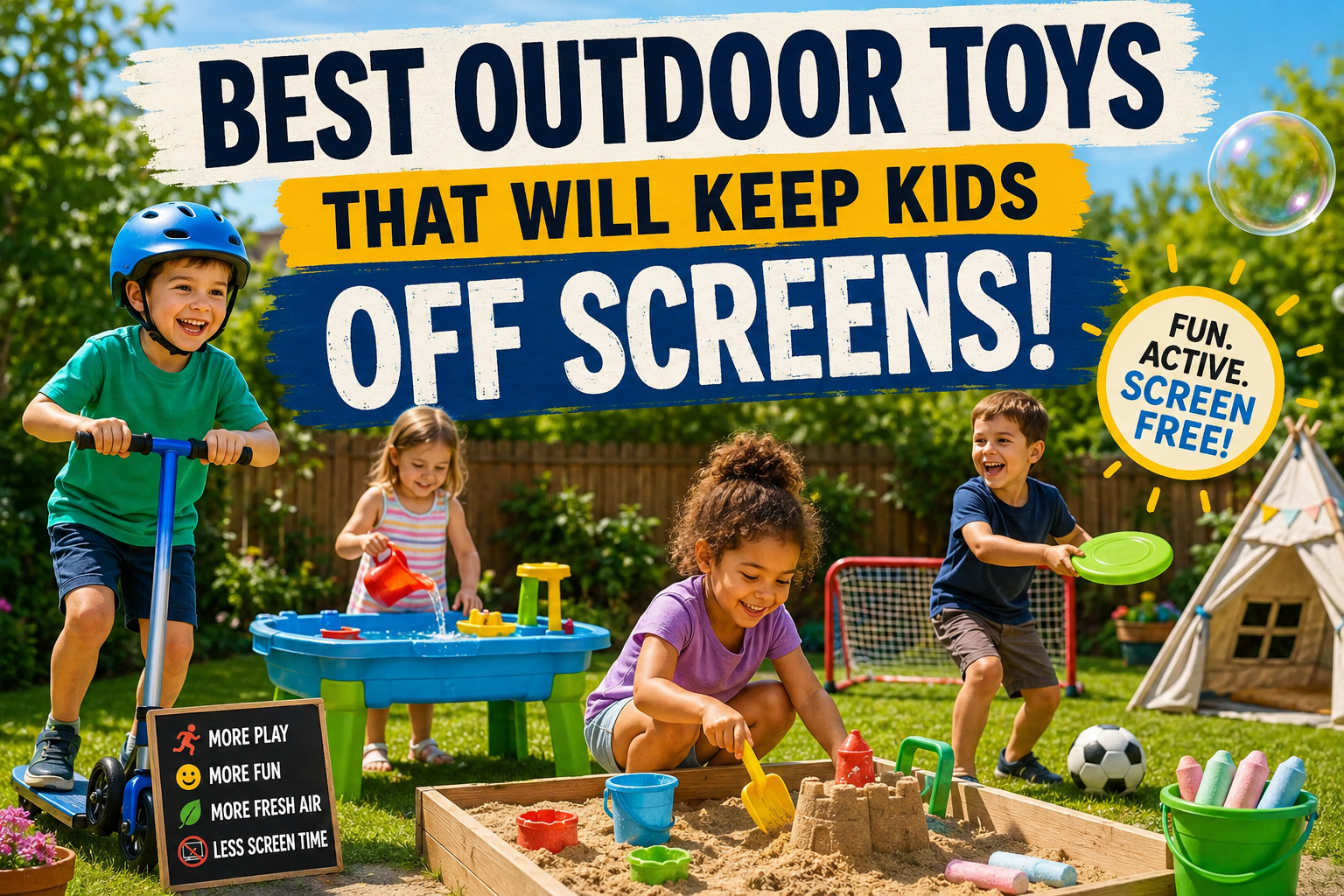
Best Outdoor Toys That Will Keep Kids Off Screens
Best Outdoor Toys That Will Keep Kids Off Screens
Getting kids away from tablets, phones, and video games can be a challenge. During summer, parents often want their children outside more, but simply telling kids to “go play outside” doesn’t always work.
The right outdoor toys can change that.
The best outdoor toys give kids something exciting to do with their hands and bodies. They encourage running, building, exploring, creating, pretending, and playing with friends. Even better, many of them help children develop important skills while they’re having fun.
If you’re looking for toys that can make screen-free outdoor play more appealing, these are some of the best options to consider.
Best Outdoor Toys at a Glance
| Outdoor Toy | Best For | Recommended Age | Activity Level | Price Range |
|---|---|---|---|---|
| Scooter | Balance and movement | 3+ | High | $$ |
| Water Table | Sensory play | 1–5 | Medium | $$ |
| Sidewalk Chalk | Creativity | 2+ | Medium | $ |
| Sandbox | Imaginative play | 2+ | Medium | $$ |
| Obstacle Course | Physical activity | 3+ | High | $$ |
| Nature Exploration Kit | Discovery and science | 3+ | Medium | $ |
| Outdoor Building Blocks | Creativity and problem solving | 2+ | Medium | $$ |
| Sports Set | Coordination and teamwork | 3+ | High | $$ |
| Bubbles | Active play | 1+ | Medium | $ |
| Gardening Set | Nature and responsibility | 3+ | Low/Medium | $ |
What Makes a Great Outdoor Toy?
The best outdoor toys don’t simply keep children occupied. They encourage kids to participate.
Look for toys that encourage movement, creativity, problem solving, exploration, pretend play, or interaction with other children.
Open-ended toys are especially valuable because children can use them in different ways as they grow. A bucket, for example, can become a sandcastle tool, a water cup, a gardening container, or part of an imaginary game.
It’s also worth considering durability. Outdoor toys have to deal with sunlight, dirt, water, and plenty of rough play.
Before buying, think about five things:
Age: Does the toy match your child’s age and abilities?
Play value: Can kids use it in multiple ways?
Development: Does it encourage useful physical, cognitive, creative, or social skills?
Durability: Can it handle regular outdoor use?
Storage: Do you have somewhere practical to put it?
The best toys check several of these boxes at once.
Our Top Outdoor Toy Picks
Best Overall: Outdoor Building Toys
Outdoor building toys are one of our favorite choices because they give children control over the play.
Kids can build towers, forts, houses, garages, roads, animal shelters, and imaginary cities. Then they can knock everything down and start again.
This type of open-ended play can keep children engaged much longer than a toy with only one function.
Best for: Creative kids, builders, and imaginative play.
Best for Active Kids: Scooters and Ride-On Toys
Scooters, balance bikes, pedal cars, and other ride-on toys give kids a reason to move.
They can practice balance, steering, coordination, and spatial awareness while exploring the driveway, sidewalk, backyard, or local park.
For younger children, choose stable, age-appropriate ride-on toys. Older children may enjoy scooters or bikes that allow them to travel farther.
Best for: Kids who always seem to be moving.
Best for Toddlers: Water Tables
Water tables are a summer favorite for a reason.
Toddlers can scoop, pour, splash, fill containers, float toys, and experiment with water. Add cups, funnels, toy boats, or plastic animals and the possibilities grow.
Water play also gives younger children a sensory experience while encouraging coordination and simple problem solving.
Best for: Toddlers and preschoolers.
Best Budget Pick: Sidewalk Chalk
You don’t need to spend a lot of money to get kids outside.
A bucket of sidewalk chalk can provide hours of creative possibilities. Kids can draw pictures, create hopscotch courses, make roads for toy cars, practice letters and numbers, or invent their own games.
Older kids can create elaborate chalk obstacle courses and giant board games.
Best for: Creative play on a budget.
Best for Exploration: Nature Kits
A magnifying glass, bug viewer, binoculars, or simple nature kit can transform a backyard into a miniature science lab.
Kids can search for insects, examine leaves, observe birds, inspect rocks, and discover how plants and animals interact with their surroundings.
Best for: Curious kids who love animals, nature, and science.
Scooters and Ride-On Toys
Scooters, balance bikes, pedal cars, and other ride-on toys are excellent choices for active kids.
They encourage children to move while developing balance, coordination, steering, and spatial awareness.
They’re also a good way to make outdoor play feel like an adventure. Instead of simply running around the yard, kids have somewhere to go and something to explore.
Best for: Active kids who enjoy movement and adventure.
Water Tables
A water table can become one of the most-used outdoor toys during summer.
Kids can scoop, pour, splash, transfer water between containers, and experiment with floating and sinking objects. Add funnels, cups, toy boats, or plastic animals to create new activities.
Parents can also introduce simple learning games. Ask your child which object floats, which container holds more water, or what happens when they pour water through different-sized funnels.
Best for: Toddlers and preschoolers.
Sidewalk Chalk
Sidewalk chalk is simple, inexpensive, and incredibly versatile.
Kids can draw pictures, make roads, create hopscotch games, practice letters, design obstacle courses, or invent giant outdoor board games.
You can even use chalk to create a movement game:
“Jump to the blue circle.”
“Run to the number five.”
“Hop across the stars.”
Suddenly, a simple drawing activity becomes a physical game.
Best for: Creative kids and families looking for inexpensive outdoor activities.
Outdoor Building Blocks
Large outdoor building blocks allow children to create almost anything they can imagine.
They can build towers, houses, forts, garages, roads, or pretend stores. Building also introduces basic concepts involving balance, size, shape, and spatial relationships.
The biggest advantage is that the toy doesn’t tell the child what to build.
The child decides.
Best for: Creative children and young builders.
Backyard Obstacle Courses
Obstacle courses are one of the easiest ways to turn physical activity into a game.
Use cones, hoops, tunnels, stepping stones, jump ropes, balance equipment, or whatever you already have around the house.
Children can crawl, jump, balance, run, and race through the course.
Even better, let them design their own.
Once kids start creating obstacle courses for siblings and friends, you’ve turned one outdoor toy into an ongoing activity.
Best for: High-energy kids.
Sandbox Toys
Sand play encourages children to dig, scoop, pour, transport, build, and create.
Buckets, shovels, molds, trucks, rakes, and other sandbox accessories can turn a simple sandbox into a construction site, beach, castle, or imaginary city.
Sand also provides tactile sensory play while helping children practice fine motor skills.
Best for: Toddlers, preschoolers, and imaginative builders.
Bubbles
Bubbles are an easy way to get younger kids moving.
Children can chase, pop, stomp, and catch bubbles. Older children can experiment with giant bubbles or create games around them.
They’re inexpensive, easy to transport, and work almost anywhere.
Best for: Toddlers and younger children.
Outdoor Sports Toys
Sports toys can turn a backyard into a miniature recreation area.
Consider beginner basketball hoops, soccer goals, tee-ball sets, bowling games, badminton, ring toss, or throwing targets.
Sports encourage physical activity while helping children develop coordination, balance, timing, and spatial awareness.
They also give parents and siblings a reason to play together.
Best for: Active children and families.
Nature Exploration Kits
Kids don’t always need another electronic gadget. Sometimes they need a reason to look more closely at the world around them like a nature kit.
Bug viewers, magnifying glasses, binoculars, butterfly nets, and nature journals can encourage children to investigate their surroundings.
Create simple challenges:
Find three different insects.
Find a leaf larger than your hand.
Find something that feels rough.
Find five different colors in the backyard.
Outdoor exploration becomes a game, and learning happens naturally.
Best for: Curious kids and budding scientists.
Gardening Toys
Gardening gives children something many toys can’t provide: a reason to return outside every day.
With child-sized gardening tools, kids can dig, plant seeds, water plants, and watch their garden grow.
It also introduces patience and responsibility. Plants don’t grow instantly, so children learn to care for something over time.
Best for: Nature-loving children.
Outdoor Pretend Play Toys
Pretend play doesn’t have to stay indoors.
Outdoor kitchens, playhouses, camping sets, pretend tool sets, and picnic toys can transform a backyard into a restaurant, campsite, workshop, or imaginary town.
Pretend play encourages storytelling, communication, creativity, and social development.
Best for: Imaginative children.
Best Outdoor Toys by Goal
Sometimes parents aren’t really looking for a specific toy. They’re looking for a solution.
Maybe their child needs to move more. Maybe they want less screen time. Maybe they want something educational.
Here’s where different types of outdoor toys can help.
| Goal | Best Outdoor Toys |
| Get kids moving | Scooters, bikes, obstacle courses, sports sets |
| Encourage creativity | Chalk, building blocks, sand toys |
| Encourage sensory play | Water tables, sandboxes, bubbles |
| Develop coordination | Balls, scooters, throwing games |
| Encourage STEM learning | Nature kits, gardening sets, magnifying glasses |
| Encourage imagination | Playhouses, outdoor kitchens, pretend-play sets |
| Encourage social play | Sports equipment, giant lawn games |
| Keep kids entertained cheaply | Chalk, bubbles, jump ropes, balls |
| Encourage independent play | Building toys, sandboxes, gardening |
| Get kids exploring | Nature kits, binoculars, bug viewers |
Best Outdoor Toys by Age
| Age | Recommended Outdoor Toys | Skills Encouraged |
| 1–2 Years | Water tables, bubbles, push toys, sand toys | Movement, sensory exploration, coordination |
| 2–3 Years | Chalk, water toys, sand toys, simple ride-ons | Creativity, balance, fine motor skills |
| 3–5 Years | Scooters, obstacle courses, pretend play, sports toys | Coordination, imagination, problem solving |
| 5–7 Years | Bikes, sports sets, nature kits, outdoor games | Balance, teamwork, exploration |
| 8+ Years | Bikes, sports equipment, lawn games, science kits | Strategy, independence, physical activity |
Always check the manufacturer’s age recommendations and safety requirements before purchasing a toy.
Best Outdoor Toys Under $25
You don’t need to spend a fortune to make outdoor play more appealing.
Some of the best affordable outdoor toys include:
- Sidewalk chalk
- Bubbles
- Jump ropes
- Flying discs
- Sand toy sets
- Nature exploration kits
- Outdoor balls
- Ring toss games
- Gardening tools
- Water-play accessories
These smaller toys can also work well as additions to larger outdoor play areas.
Best Outdoor Toys for Kids Who Don’t Like Sports
Not every child wants to play soccer or basketball.
If your child isn’t interested in traditional sports, choose toys that make movement part of another activity.
Try sidewalk chalk, nature kits, water tables, gardening tools, sand toys, building blocks, bubbles, or outdoor pretend-play sets.
A child who doesn’t want to “exercise” may happily spend an hour searching for bugs, building a sand city, or creating a chalk obstacle course.
That’s still active play.
Best Outdoor Toys for Small Yards
You don’t need a huge backyard to create a fun outdoor play area.
For smaller spaces, look for toys that are compact, portable, or easy to store.
Sidewalk chalk, bubbles, scooters, jump ropes, compact water tables, sand tables, nature kits, and stackable building toys are excellent choices.
A few versatile toys can provide more value than a backyard filled with equipment that rarely gets used.
How to Create a Screen-Free Backyard
You don’t need to turn your backyard into an amusement park.
Instead, create a few simple play zones.
The Movement Zone
Add a scooter, balls, jump rope, or obstacle-course equipment.
This gives kids a place to run, jump, balance, and practice physical skills.
The Creative Zone
Add sidewalk chalk, outdoor building blocks, or simple art supplies.
Kids can draw, build, design, and create their own games.
The Sensory Zone
A water table, sandbox, mud kitchen, or simple sensory toys can give younger children hours of hands-on play.
The Discovery Zone
Add a magnifying glass, binoculars, bug viewer, or gardening tools.
This gives children a reason to investigate nature.
The Imagination Zone
A playhouse, outdoor kitchen, camping set, or pretend-play toys can turn the backyard into a completely different world.
You don’t need every zone. Start with the types of play your child already enjoys.
How to Keep Kids Interested in Outdoor Toys
Buying outdoor toys is only the beginning.
Kids can get bored with almost anything if they use it exactly the same way every day.
Toy rotation can help.
Keep some toys stored away and bring them back every few weeks. A toy that seemed boring last month can feel completely new when it returns.
You can also create simple challenges.
Ask your child to build the tallest tower, create an obstacle course, find five different leaves, make a chalk city, build a sandcastle, or invent a new backyard game.
The goal isn’t to control the play.
Give them a starting point, then let their imagination take over.
Outdoor Toy Safety Tips
Outdoor play should be fun, but parents should still pay attention to safety.
Check the manufacturer’s age recommendations before buying a toy. Avoid toys with small parts for children who are still at risk of choking.
Children using scooters, bikes, and similar ride-on toys should use appropriate protective equipment, including helmets when recommended.
Water play requires close adult supervision. Young children should never be left unattended around water, even when the water is shallow.
Inspect outdoor toys regularly for cracks, loose parts, sharp edges, or other damage. Store toys properly when they’re not being used, especially after extreme weather.
And don’t forget the basics of summer safety: shade, hydration, sunscreen, and breaks from the heat.
Outdoor Toys Keep The Kids Busy
The best outdoor toys don’t simply keep kids busy.
They give kids a reason to move, explore, create, and interact with the world around them.
You don’t need to buy dozens of toys or build an elaborate backyard play area. Start with a few versatile toys that match your child’s interests.
A scooter for movement. Chalk for creativity. A water table for sensory play. A nature kit for exploration. Maybe a ball or outdoor game for family time.
The goal isn’t to eliminate screens completely.
It’s to give kids something worth putting the screen down for.
Frequently Asked Questions
What are the best outdoor toys to keep kids off screens?
Some of the best screen-free outdoor toys include scooters, bikes, water tables, sidewalk chalk, sand toys, outdoor building blocks, sports equipment, obstacle-course toys, bubbles, and nature exploration kits.
What outdoor toys are best for toddlers?
Water tables, bubbles, sand toys, push toys, sidewalk chalk, and simple ride-on toys are excellent options for toddlers. Always check the manufacturer’s recommended age range and safety instructions.
What outdoor toys keep kids active?
Scooters, bikes, obstacle courses, jump ropes, sports equipment, flying discs, and ride-on toys encourage kids to move while having fun.
What are the best outdoor toys for creative kids?
Sidewalk chalk, outdoor building blocks, sand toys, gardening sets, nature kits, and pretend-play toys give creative children plenty of opportunities to invent their own games.
What are the best outdoor toys for summer?
Water tables, sprinklers, scooters, bikes, sidewalk chalk, sandboxes, bubbles, sports sets, and nature exploration toys are excellent summer choices.
How can I get my child to play outside instead of using a tablet?
Make outdoor play easy and interesting. Keep a few favorite toys accessible, create simple challenges, invite siblings or friends outside, and rotate toys to keep things fresh.
What are the best outdoor toys for small yards?
Sidewalk chalk, bubbles, scooters, jump ropes, compact water tables, small sand tables, nature kits, and stackable building toys work well in smaller outdoor spaces.
Are outdoor toys educational?
Yes. Many outdoor toys help children develop coordination, balance, spatial awareness, creativity, communication, observation, problem solving, and social skills. The learning happens naturally through play.
How many outdoor toys does a child need?
You don’t need dozens. A small collection that supports different types of play can provide plenty of variety. Consider choosing one active toy, one creative toy, one sensory toy, one imaginative toy, and one exploration toy.
Amazon Affiliate Disclosure: This article may contain affiliate links. If you purchase a product through one of these links, we may earn a commission at no additional cost to you. We only recommend products we believe offer useful value for families.