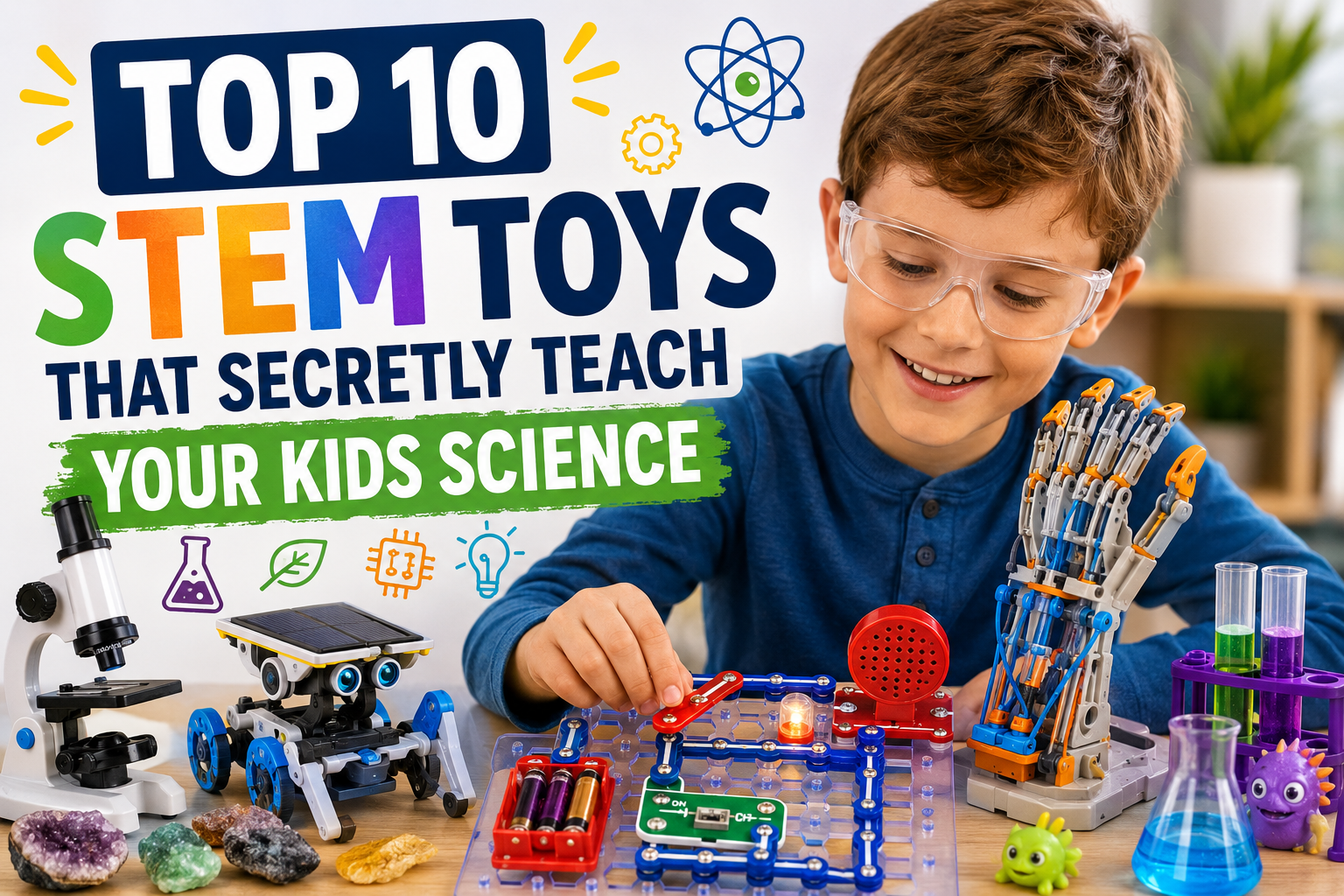
Top 10 STEM Toys That Secretly Teach Your Kids Science (They’ll Love #7!)
10 STEM Toys That Teach Your Kids Science
Kids don’t need another toy that flashes, beeps, and gets forgotten in three days.
The best STEM toys make kids do something. They build a circuit, test a magnet, launch a vehicle, examine a specimen, construct a machine, or figure out why something didn’t work.
That’s where the real learning happens.
And here’s the clever part: your child may never realize they’re learning science.
Research and testing from major parenting and technology publications consistently point toward hands-on STEM toys as a way to encourage experimentation, problem-solving, curiosity, and active learning. Good STEM toys don’t simply provide answers. They give kids something to figure out.
Best STEM Toys at a Glance
| Rank | STEM Toy | What It Secretly Teaches | Best For |
|---|---|---|---|
| 1 | National Geographic Earth Science Kit | Geology, chemistry, earth science | Ages 8+ |
| 2 | Snap Circuits Jr. | Electricity and electronics | Ages 8+ |
| 3 | Educational Insights GeoSafari Microscope | Biology and observation | Ages 7+ |
| 4 | Discovery #MINDBLOWN Solar Robot | Solar energy and engineering | Ages 8+ |
| 5 | Learning Resources Super Magnet Lab | Magnetism and physics | Ages 8+ |
| 6 | Learning Resources Machine Makers | Physics and mechanical engineering | Ages 5+ |
| 7 | Learning Resources Beaker Creatures | Chemistry and reactions | Ages 5+ |
| 8 | Thames & Kosmos Mega Cyborg Hand | Anatomy, hydraulics and engineering | Ages 7+ |
| 9 | Thames & Kosmos Easy Electric Circuits | Electricity and physical science | Ages 8+ |
| 10 | Thames & Kosmos SolarFlower | Solar energy and renewable power | Ages 8+ |
Editor’s Recommendation
If I had to buy just one, I’d start with Snap Circuits Jr. It gives kids a physical way to understand electricity instead of simply reading about it. The pieces snap together, projects actually work, and the child can change the circuit and immediately see what happens.
That’s exactly what you want from a STEM toy: experiment → observe → change → try again.
1. National Geographic Earth Science Activity Kit
Best for: Earth science, geology and chemistry
Recommended age: 8+
What looks like a collection of messy science experiments is actually a crash course in earth science.
The National Geographic Earth Science Activity Kit lets kids explore topics such as geology, volcanoes, crystals and weather-related science through hands-on activities. The current kit includes experiments designed around earth science concepts.
What kids are really learning
They’re learning that science isn’t just something that happens in a textbook.
They make a prediction, perform an experiment, observe the result and figure out what caused it.
That’s the beginning of scientific thinking.
Why parents should like it
It’s also a good choice for kids who love dinosaurs, rocks, volcanoes or anything involving explosions. You can turn the experiments into a larger learning activity by taking a weekend trip to look for interesting rocks or geological formations.
2. Snap Circuits Jr. SC100
Best for: Electricity and electronics
Recommended age: 8+
This is one of my favorite types of STEM toy because the science is impossible to ignore.
Snap Circuits Jr. uses components that snap together to create working electronic projects. The SC100 includes more than 100 projects and introduces children to basic electrical engineering without requiring soldering or specialized tools.
Kids aren’t just following directions.
They’re discovering that a switch can control electricity, that circuits need a path, and that changing components changes what the system does.
That makes concepts such as current, switches, conductivity and circuits much easier to understand.
And once a kid gets the first light bulb working?
They’re usually hooked.
3. Educational Insights GeoSafari Microscope
Best for: Biology and scientific observation
Recommended age: 7+
A microscope can turn an ordinary afternoon into an investigation.
The GeoSafari microscope sets available for children introduce magnification and observation with prepared slides and equipment designed for young scientists. One current version offers 50x to 400x magnification along with slides, a petri dish, eyedropper and activity journal.
The science lesson here is simple but powerful:
Look closer.
A leaf doesn’t look the same under magnification. A piece of fabric suddenly has a structure. Tiny objects become interesting.
This teaches kids to observe instead of simply glance.
Try this
Have your child create a “science detective” notebook.
They can examine leaves, fabric, salt, sugar, hair or other safe household samples and draw what they see.
Now you’ve turned a toy into a mini biology lab.
4. Discovery #MINDBLOWN Solar Vehicle Robot
Best for: Solar energy and engineering
Recommended age: 8+
Want to introduce renewable energy without giving your child a lecture about renewable energy?
Give them a solar robot.
This kit lets children build different solar-powered robots and vehicles. The solar panel provides the power, allowing kids to see the connection between sunlight, energy and motion.
The hidden science lesson
Your child is learning about:
- Solar energy
- Electrical energy
- Motors
- Mechanical movement
- Engineering design
- Cause and effect
The best part is that sunlight becomes the explanation.
No batteries required.
5. Learning Resources Super Magnet Lab
Best for: Magnetism and physics
Recommended age: 8+
Magnets are one of those rare science topics that kids can understand with their hands before they understand the vocabulary.
The Super Magnet Lab gives kids different magnetic components and activities for exploring magnetic forces and related scientific concepts.
Kids can test what attracts, what doesn’t, how magnets interact and how distance changes the effect.
Eventually they’re learning about concepts such as:
force, attraction, repulsion and magnetic fields.
They just don’t call it physics.
That’s the secret.
6. Learning Resources STEM Explorers Machine Makers
Best for: Engineering and mechanical physics
Recommended age: 5+
This one is especially good for younger kids who love building things.
Machine Makers lets children construct moving STEM creations based on real-world machines and mechanical systems. The set focuses on movement, construction and engineering concepts.
Your child may think they’re simply building a cool machine.
They’re actually learning about:
motion, gears, mechanical advantage, force and structure.
It’s also a great introduction to the idea that engineers don’t necessarily get something right on the first attempt.
Build it.
Test it.
Fix it.
Build it again.
That mindset matters.
7. Learning Resources Beaker Creatures Liquid Reactor Super Lab
Best for: Chemistry
Recommended age: 5+
Some kids love robots.
Others want to mix mysterious liquids and see what happens.
For the second group, Beaker Creatures makes a strong STEM toy.
The kit uses fizzing reactions and hands-on activities to introduce young children to scientific observation and chemical reactions.
Instead of saying:
“Today we’re going to learn about chemical reactions.”
You can ask:
“What do you think is going to happen?”
That’s a much better question.
Prediction is a major part of scientific thinking, and toys like this give children a reason to make predictions and test them.
8. Thames & Kosmos Mega Cyborg Hand
Best for: Anatomy, hydraulics and engineering
Recommended age: 7+
This is one of those toys that looks like a gimmick until you realize how much science sits underneath it.
The Mega Cyborg Hand lets children construct a working hand and explore how hydraulic systems can create movement. The design can be configured in different ways, including a claw-like configuration.
The child gets a surprisingly useful introduction to:
- Hydraulics
- Pressure
- Mechanical movement
- Human anatomy
- Engineering design
It’s especially useful for kids who are fascinated by robots, prosthetics or machines.
9. Thames & Kosmos Easy Electric Circuits
Best for: Electricity and physical science
Recommended age: 8+
If your child is curious about how things work, electric circuits are worth exploring.
The Easy Electric Circuits kit lets children build 20 circuits and motorized devices while experimenting with different electrical components and physical science principles.
This type of kit is valuable because the child can change one part of the system and see the result.
That’s much more memorable than memorizing definitions.
A simple challenge
Ask your child to build something that:
- Turns on a light
- Makes a motor move
- Uses a switch
- Does something different when the circuit changes
Don’t immediately help.
Let them troubleshoot.
A little frustration here is actually useful.
10. Thames and Kosmos SolarFlower
Best for: Solar energy and renewable energy
Recommended age: 8+
The SolarFlower is a clever way to introduce renewable energy because kids can actually see the energy source working.
The 2026 version uses a solar-powered motor and lets children assemble a flower with 114 pieces before placing it in sunlight and watching the petals move. The kit includes four experiment ideas.
This creates an easy connection between:
Sunlight → solar panel → electricity → motor → movement
That’s a complete energy system sitting on a child’s desk.
And it doesn’t feel like homework.
Why These STEM Toys Actually Work
Here’s the difference between a good STEM toy and a toy with “STEM” printed on the box.
A good STEM toy creates a problem to solve.
Your child has to make something work.
They have to figure out why it failed.
They have to change something.
Then they try again.
That process matters more than the fancy packaging.
STEM toys can introduce children to science, technology, engineering and math through active play, particularly when kids get opportunities to build, experiment, test ideas and solve problems.
Look for these five things
When you’re shopping for STEM toys, look for toys that encourage experimentation, construction, prediction, troubleshooting and open-ended play.
A toy that has one correct result and takes five minutes to complete may provide entertainment.
A toy that lets your child build ten different things, break them, modify them and try again can become a learning system.
That’s a much better investment.
The Best STEM Toy by Learning Goal
Want to teach electricity? Start with Snap Circuits.
Want to teach biology? Get a microscope.
Want to introduce chemistry? Try a hands-on science lab.
Want to teach physics? Magnets and mechanical machines are excellent starting points.
Want to introduce renewable energy? Pick a solar-powered building kit.
Want to encourage engineering? Choose a construction or robotics kit that requires repeated testing.
You don’t need to buy ten STEM toys.
One good toy that gets used repeatedly beats a shelf full of expensive educational toys collecting dust.
How to Make a STEM Toy Even More Educational
Here’s the easiest trick.
Don’t explain everything.
Instead, ask questions.
“What do you think will happen?”
“Why do you think that happened?”
“What could we change?”
“Can you make it work differently?”
“What happens if we make this part longer?”
“What happens if we remove this piece?”
These questions turn passive toy use into an experiment.
And you don’t need to know every answer.
That’s actually a good thing.
Look it up together.
STEM Toys Don’t Have to Feel Like School
This may be the biggest reason I like hands-on STEM toys.
Kids don’t need to sit down and hear a 20-minute explanation of physics.
Give them a marble run.
Give them magnets.
Give them a circuit kit.
Give them a microscope.
Then let curiosity take over.
The strongest STEM toys blur the line between play and learning. That’s exactly why they can be so effective. Recent STEM toy testing and buying guides consistently favor products that make kids actively build, experiment and solve problems rather than simply watch or press buttons.
Science Starts When Kids Ask
The best STEM toy isn’t necessarily the one with the most pieces, the biggest price tag or the most impressive packaging.
It’s the one that makes your child ask:
“What happens if I try this?”
That’s where science starts.
Give them something they can build, break, test and rebuild. Let them make mistakes. Ask questions instead of immediately giving answers.
Before you know it, your child isn’t just playing with a toy.
They’re thinking like a scientist.
Frequently Asked Questions About STEM Toys
What are STEM toys?
STEM toys are toys designed to encourage learning or exploration related to science, technology, engineering and mathematics. They can include science experiment kits, construction sets, coding robots, microscopes, magnetic building toys, electronics kits and mechanical building systems.
What age should kids start using STEM toys?
Kids can start exploring STEM concepts very young. Younger children can use blocks, magnetic construction toys, sorting games and simple cause-and-effect toys. Older children can move into circuits, microscopes, chemistry kits, robotics and engineering challenges.
The key is choosing a toy that matches the child’s developmental level.
Are STEM toys actually educational?
They can be, but the STEM label alone doesn’t guarantee educational value.
The better question is: What does the child actually have to do?
Toys that require children to build, test, predict, observe, solve problems and modify designs generally provide more meaningful STEM learning opportunities than toys that simply deliver information.
Are STEM toys better than screen-based learning?
Not necessarily, but hands-on toys offer something screens can’t fully replicate: physical experimentation.
When a child builds a machine and watches it fail, they can physically change the design and test it again. That direct feedback can make abstract concepts easier to understand.
What’s the best STEM toy for a child who doesn’t like science?
Don’t buy a science toy.
Buy something connected to what they already love.
A child who likes robots might enjoy a mechanical building kit. A child who loves crafts might enjoy a construction set. A child who likes animals might love a microscope. A child who likes cars might enjoy a motorized engineering kit.
Start with the interest.
Sneak the science in afterward.
Are expensive STEM toys better?
No.
Price doesn’t determine educational value.
A $20 magnet kit that gets used every weekend can provide more value than a $150 robot that gets opened once and forgotten.
Look for repeatability, experimentation and open-ended play.
What is the best STEM toy overall?
For a broad introduction to STEM, I’d choose Snap Circuits Jr. It introduces real electrical concepts, offers many projects and gives children immediate feedback when they change a circuit.
For younger children, mechanical building sets and magnetic construction toys can be better starting points.
Amazon Affiliate Disclosure: This article may contain affiliate links. If you purchase a product through one of these links, we may earn a commission at no additional cost to you. We only recommend products we believe offer useful value for families.